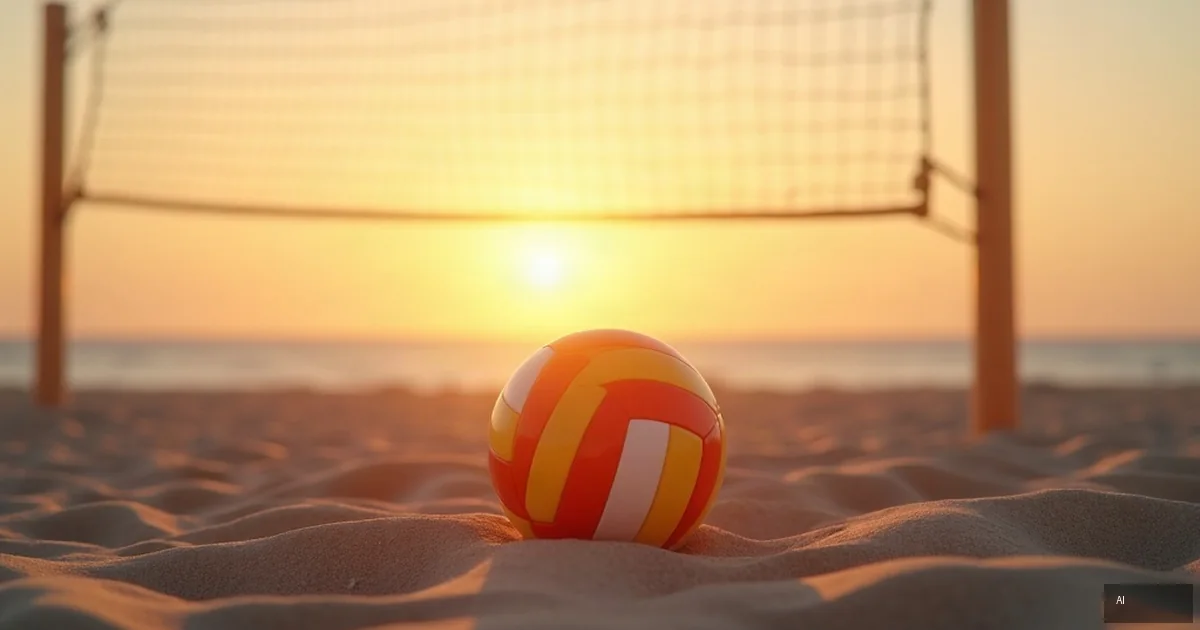
🏐 Birth of Volleyball
Volleyball was invented in 1895 by William G. Morgan — YMCA physical education director in Holyoke, Massachusetts. He wanted to create a less physically demanding sport than basketball (invented just 10 miles away) that would suit older men. Initially, the game was called “Mintonette.”
Volleyball quickly became popular through the YMCA network and spread worldwide. In 1947, FIVB (Fédération Internationale de Volleyball) was founded — the international volleyball federation. At the 1964 Tokyo Olympic Games, volleyball became an Olympic sport.
🏐 Evolution of Indoor Volleyball
Indoor volleyball has been an Olympic sport since 1964. Two teams of 6 players play on a court divided by a net. The rules evolved: the libero was introduced (defensive player, 1998), and the rally point system (each point ends with a score, 1999).
Key elements: serve, reception, set, attack, block. Rotation after each won serve forces players to be all-round.
🏖️ Beach Volleyball
Beach volleyball was born in the 1920s in Santa Monica, California, but it formed as a professional sport in the 1980s. At the 1996 Atlanta Olympic Games, beach volleyball became an Olympic event.
Key differences from indoor volleyball: only 2 players per team, a smaller court, play on sand, no libero. It is physically very demanding due to sand resistance.
Legendary beach volleyball pairs: Karch Kiraly/Kent Steffes (USA — 3 Olympic golds), Kerri Walsh Jennings/Misty May-Treanor (USA — 3 Olympic golds in women's competition).
🌟 Legendary Volleyball Teams
Brazil
Multiple-time Olympic and world champions. Volleyball in Brazil is the second religion after football.
Russia/USSR
The Soviet Union dominated men's volleyball in 1960-1980. Russia continues the tradition.
Italy
Dominated in 1990-2000 — 3 world champion titles. Known for tactical play.
Poland
The current men's volleyball superpower — 2 world champion titles (2014, 2018).
🇱🇹 Lithuanian Volleyball
Volleyball began to be played in Lithuania in the early 20th century. During the Soviet occupation, Lithuanian volleyball players successfully competed in the USSR league. After the restoration of Independence, the Lithuanian men's and women's national teams regularly participate in European Championship qualifiers.
In Lithuania, both indoor and beach volleyball tournaments are popular. Beach volleyball championships take place in Palanga, Nida, and by the lakes near Vilnius and Kaunas. Youth volleyball programs are expanding in schools and universities.
🥗 Athlete Nutrition and Historical Diet
The history of sport is inseparable from the evolution of nutrition. Every sport has its own nutritional traditions and requirements. Athletes in all eras have sought ways to improve their performance through food.
- Protein — for muscle repair and growth. For athletes, 1,6-2,2 g/kg of body weight per day is recommended
- Carbohydrates — the main energy source for intense training
- Healthy fats — for hormone production and reducing inflammation
- Vitamins and minerals — micronutrients essential for optimal body functioning
- Hydration — even 2% dehydration can reduce athletic performance
💊 Sports Supplements — Modern Support for Athletes
Although historical sports flourished without supplements, modern athletes can take advantage of scientific advances. Properly selected sports supplements can help achieve better results.
| Supplement | Purpose | Recommended dose | When to take |
|---|---|---|---|
| Whey protein | Muscle Recovery and Growth | 20-40 g after training | After training, between meals |
| Creatine | Strength Gain, Muscle Volume | 3-5 g per day | At any time, consistently |
| BCAA | Muscle Protection, Recovery | 5-10 g before/after training | Before and after training |
| Omega-3 | Inflammation reduction, joint health | 1-3 g per day | With food |
| Magnesium | Muscle Relaxation, Sleep | 300-400 mg per day | In the evening before sleep |
🏋️ Training Principles — From History to Modern Methods
Regardless of the sport, the basic training principles remain the same throughout history. Modern sports science confirms what the best athletes intuitively knew for centuries.
Progressive Overload
Gradually increase the load — weight, repetitions or distance. The body adapts to stress, so constant progression is essential.
Periodization
Divide training into cycles: preparation, competition and recovery. This helps avoid overtraining.
Specificity
Training must match the requirements of the sport. A runner must run, a weightlifter must lift weights.
Recovery
Muscles grow and strengthen not during training but during rest. Sleep is the most important part of recovery.
🏥 Injury Prevention in Sports
Injuries are an unavoidable part of sports history — from ancient Olympians to modern professionals. However, most injuries can be prevented by following basic prevention principles.
- Warm-up — 10-15 minutes of dynamic warm-up before every training session
- Stretching Exercises — regular stretching increases flexibility and reduces injury risk
- Proper Technique — incorrect technique is the most common cause of injuries
- Proper Equipment — footwear and protective equipment must meet the requirements of the sport
- Gradual Load Increase — no more than per week
- Rest Days — at least 1-2 rest days per week are essential
- Listening to Your Body's Signals — pain is a signal, not a sign of weakness