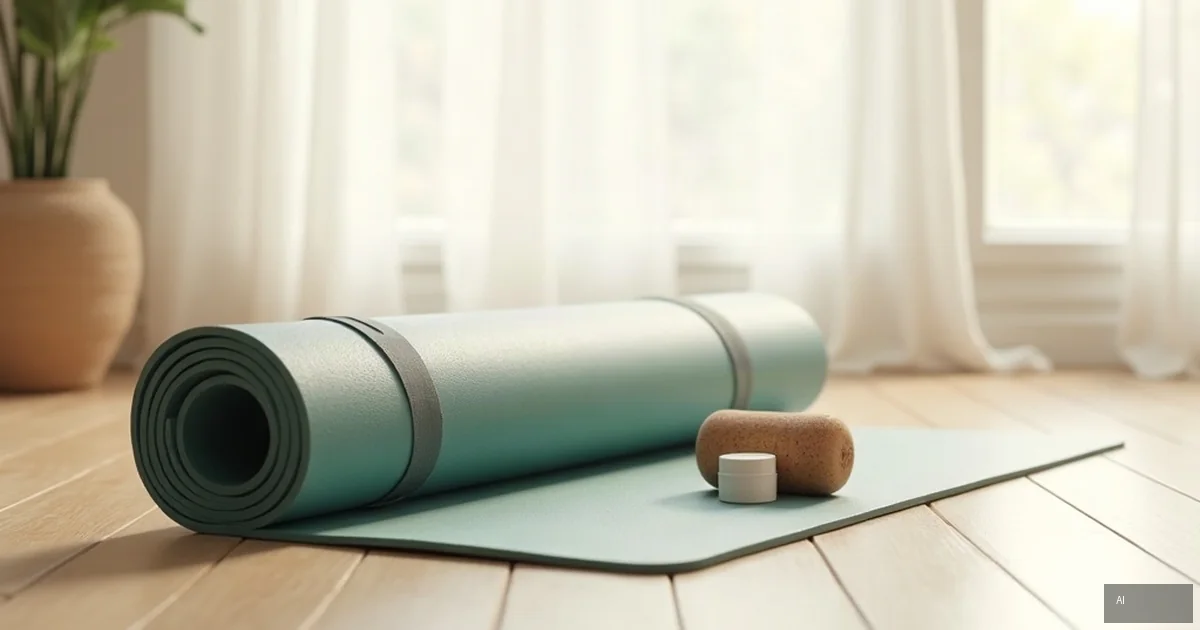
🧰 How to Choose a Roller
- Soft (foam) — for beginners, sensitive areas
- Intermediate — a universal choice for most people
- Hard — for more pressure when soft is already too weak
- With bumps — greater local pressure, but also a greater risk of overdoing it
- Short roller — more convenient when traveling; a long one — more convenient for the back and thighs
⏱️ How to Roll
- Place the roller on the mat, put the muscle on it and let your weight settle over a few seconds
- Movement — slow, 2–3 cm per second. This is not quick stroking
- 30–60 s in one spot. If you find a sensitive point — stop there and breathe, rather than rolling over it
- 1–2 minutes for the whole area
- Breathing should remain free — held breath raises muscle tone
📍 Where and for What
- Thighs (front, back) — the largest area, the simplest technique
- Calves — a sticky muscle sheath that takes pressure well
- Glutes — better with a ball, because a roller has difficulty reaching it
- Mid-back (between the shoulder blades) — carefully, just not on the spine
- Chest, armpits, neck — do not do it where nerves and blood vessels are sensitive
⏰ Before or After Training
If the goal is to feel loose before training, do 30–60 s in one spot and do not overdo it: rolling for too long before strength training can temporarily reduce strength.
After training, it is more useful when you feel “stiffness” — 1–2 minutes for the area that worked the most.
⚠️ Where Not to Roll
- Directly on the spinal vertebrae and the front of the neck
- On bony prominences, elbows, and iliac bones
- On an area that has been injured in recent days
- On bruises, swelling, hot red areas
Read also fascial release, massage gun — how these three methods differ.
What Foam Rolling Is and What to Expect
Foam rolling is self-applied pressure on muscles and surrounding tissues with a roller, often called self-massage. After rolling, people usually feel a short-term sense of looseness and greater range of motion, but it is not a miracle: the effect is temporary and has nothing to do with the alleged elimination of risks. The main value is low cost, simplicity, and the ability to do it at home.
🔄 Common Mistakes
- Moving too fast — roll slowly, about 2–3 cm per second; rushing brings no benefit.
- Staying too long on one sensitive point — better briefly several times than once until it hurts.
- Rolling over bones and joints — a roller is intended for muscles, not vertebrae, knees, or elbows.
- Held breath — tension prevents the muscle from relaxing; breathe slowly and deeply.
- Rolling on a fresh injury — bruises, swelling, or sharp pain are not a signal to press harder.
📅 Sets, Duration, and Frequency
- For one area — 30–60 seconds, up to 2–3 passes.
- For the whole body — 5–10 minutes per session is enough for a few targeted areas.
- How Often — daily brief sessions are acceptable if there is no discomfort; before strength training, prolonged rolling may temporarily reduce strength, so in that case choose a short warm-up.
- When Most Effective — after training or at a separate time, as part of relaxation.
If you want to compare with other methods, see. fascial release and massage gun.
🙋 Frequently Asked Questions
Does Rolling Replace Stretching? No — they are different methods that complement each other; after rolling it is often easier to stretch (see. stretching exercises).
Can I Roll Every Day? Yes, if there is no pain and no swelling; the most important thing is not to overdo the pressure.
What Roller Is Best for a Beginner? Soft or medium-firm — it allows you to get used to the sensation without too much discomfort.