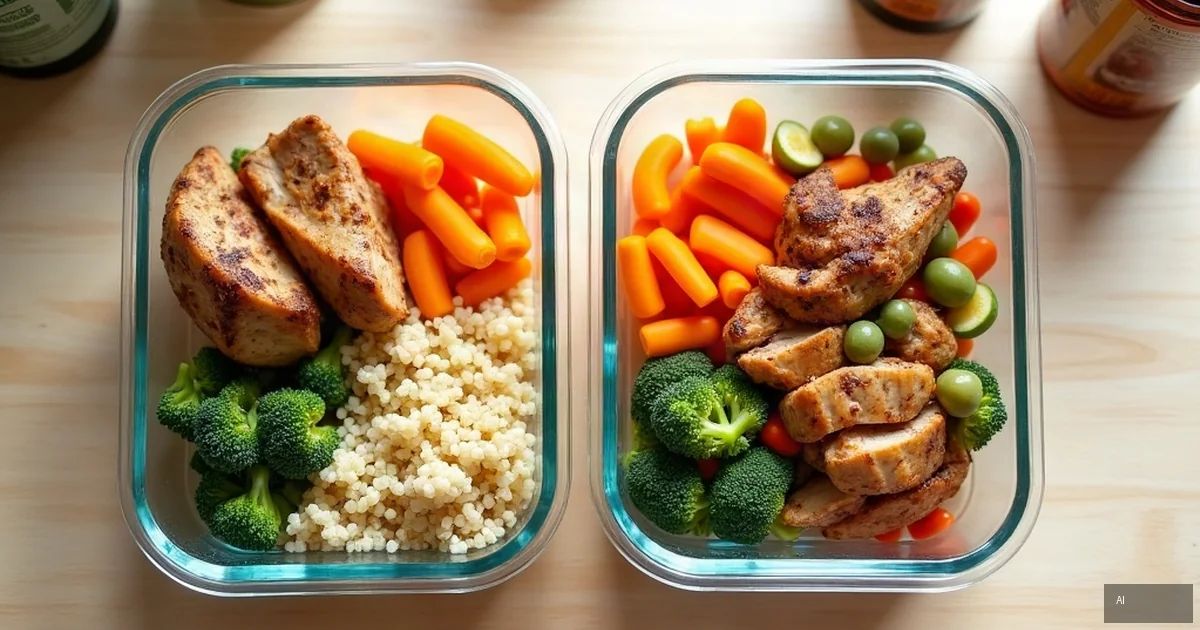
What Is Macro Flexibility (IIFYM)?
IIFYM (If It Fits Your Macros) is a nutrition philosophy according to which there is no “good” or “bad” food as long as your daily macronutrient (protein, carbohydrate, fat) goals are met. It is the opposite of strict diets that ban entire food groups.
Key Principle: 80% of your calories should come from nutritious, unprocessed food (whole grains, lean proteins, vegetables, fruits). The remaining 20% can be “flexible” — pizza, ice cream, or chocolate, if it fits within your macro limits. This is called the 80/20 rule.
📊 IIFYM vs Traditional Diets: Comparison
| Criterion | IIFYM (Flexible Diet) | Traditional Strict Diet |
|---|---|---|
| Food Choices | ✅ Free — any food that fits your macros | ❌ Limited — “allowed” and “forbidden” foods |
| Social Life | ✅ Easy — you can eat at restaurants and parties | ❌ Difficult — you often decline social opportunities |
| Long-Term Sustainability | ✅ High — flexibility reduces “diet fatigue” | ❌ Low — strict rules lead to breakdown |
| Body Composition | ✅ The same — there is evidence of an equivalent effect | ✅ The same — there is no difference if calories are equal |
| Micronutrients | ⚠️ Needs monitoring — if too much junk food | ✅ Good — if the diet is complete |
| Psychological Impact | ✅ Positive — less guilt, fewer binge-eating episodes | ❌ Negative — "all or nothing" mentality |
| Suitable for Beginners? | ⚠️ Requires discipline — you need to track macros daily | ✅ Simpler — clear rules |
📝 How to Start: 5-Step Plan
- Calculate TDEE: Use the Mifflin-St Jeor formula from our "Calorie Counting" guide.
- Set macro targets: Protein 1.6-2.2 g/kg, fat 0.8-1.2 g/kg, remaining calories — carbohydrates.
- Choose an app: MyFitnessPal (free) or Cronometer (more detailed). Set macro targets in grams, not percentages.
- Follow the 80/20 rule: 80% of daily calories — whole foods. 20% — a "flexible" choice. Example: 2500 kcal × 20% = 500 kcal for flexibility.
- Track progress: Weigh yourself every morning, calculate the weekly average. After 2 weeks, adjust calories +/- 200 kcal based on results.
🍽️ Practical IIFYM Daily Example (2500 kcal)
Here's what a flexible day looks like, with 80% nutritious food and 20% "flexibility":
| Meal | Food | Kcal | Protein | Carbs | Fat |
|---|---|---|---|---|---|
| Breakfast (8:00) | Oatmeal + whey protein + banana | 520 | 42g | 68g | 12g |
| Lunch (13:00) | Chicken breast (180g) + quinoa (150g) + salad | 550 | 55g | 50g | 14g |
| Snack (16:00) | Greek yogurt + berries + granola | 310 | 25g | 35g | 8g |
| Dinner (19:00) | Salmon (150g) + sweet potatoes (250g) + broccoli | 590 | 40g | 55g | 18g |
| 🍕 Flexibility (21:00) | 2 slices of pizza (300 kcal) | 300 | 12g | 30g | 14g |
| Total | 2270 | 174g | 238g | 66g |
🧠 Most Common Myths About IIFYM
🍩 Myth: "I Can Eat Only Cookies"
Fact: Although technically possible, micronutrient deficiency will quickly affect health, energy and sports performance. IIFYM requires responsibility.
📉 Myth: "IIFYM Doesn't Deliver Results"
Fact: There are dozens of data points showing that body composition changes depend on calorie and macro balance, not on food source. IIFYM works.
🏋️ Myth: "Only Suitable for Bodybuilders"
Fact: Everyone applies IIFYM — from endurance athletes to CrossFit athletes. Flexibility helps maintain the diet in the long term.
🕐 Myth: "Too Complicated for Beginners"
Fact: The first 1-2 weeks require effort, but later it becomes automatic. Apps make the process easier, down to a few minutes per day.
🛒 Recommended Supplements
Choose quality supplements to achieve your goals:
🔗 Related Tools
💡 Practical Everyday Tips
Implement these tips gradually — start with one and add another when the first becomes a habit:
- Start with Small Changes: Instead of radical diet changes, start with one improvement per week. Small, consistent changes are believed to be 3x more effective in the long term than drastic overhauls.
- Track progress objectively: Use a diary or app to see real data rather than relying on subjective impressions.
- Create a Supportive Environment: Prepare meals in advance (meal prep), remove trigger foods from home, keep healthy snacks on hand.
- Be Patient: Results do not come overnight. On average, it takes 2-4 weeks to notice significant changes.
⚡ Pro Tips From Experts
Sports nutrition specialists share tips that can fundamentally change your approach:
- 80/20 rule: Give 80% of your attention to the basics (calories, protein, vegetables), and 20% to details (meal timing, supplements). Perfectionism is the biggest enemy of progress.
- Listen to your body: No tests or calculations can replace your body's signals. If you feel bad, something is wrong, even if "according to the numbers" everything is fine.
- Sleep First: No nutrition strategy can compensate for lack of sleep. 7-9 hours of quality sleep is part of the nutrition plan.
- Consistency > Perfectionism: A good 80% plan that you follow 90% of the time is better than a 100% perfect plan that you follow 50% of the time.
❓ Frequently Asked Questions
Do These Recommendations Suit All Athletes?
Every athlete's body is unique. The recommendations on this page are general guidelines based on the latest scientific research. Individual needs may differ depending on the sport, intensity, age, sex, and health status. We recommend consulting a sports dietitian or doctor for a personal plan.
How Quickly Will I See Results?
It depends on your starting condition, goals, and consistency. Subjective changes (better well-being, more energy) are usually noticed within the first 1-2 weeks. Objective changes (body composition, sports performance, blood markers) typically require 4-12 weeks of consistent work.
Can I Combine It with Other Strategies?
Yes, most of the principles described on this page are compatible with other nutrition and training strategies. The most important thing is to introduce changes gradually and monitor how your body responds to them.